Your Complete Guide To Brand Positioning For SaaS
Craft SaaS brand positioning that clarifies your audience, sharpens differentiation, and turns every touchpoint into a must‑have product story.

Brand positioning is the difference between “nice product” and “must‑have platform” in SaaS. Product positioning is a strategic approach that defines how your SaaS product is perceived in the market relative to competitors.
When founders nail it early, every design decision, website headline, and campaign suddenly has a clear job. Conducting a competitive analysis is crucial in shaping effective brand positioning for SaaS, as it helps identify differentiators and refine messaging to stand out in the marketplace.
This guide walks SaaS founders through a practical, 9-step process to define sharp brand positioning, from audience and differentiation to messaging and design execution. It shows how to turn positioning into concrete decisions across product, marketing, and sales, and when to revisit it as the market evolves.
Book a free brand design day
What brand positioning really is
Brand positioning is the deliberate way you want your SaaS to be perceived relative to alternatives in the market. It defines who you are for, what problem you solve, how you solve it differently, and why that difference matters. Effective brand positioning relies on identifying the core elements—such as target audience, unique value proposition, and competitive differentiation—that are essential for a strong strategy.
Brand positioning and marketing positioning are closely related; together, they help differentiate your SaaS product in a crowded market and shape how customers perceive your offering.
For SaaS, positioning becomes the backbone of your product story, pricing logic, onboarding, and, eventually, your category narrative. Effective brand positioning starts with understanding what specific problems your product solves for customers, using insights from customer interviews and social proof to highlight your unique solutions.
If you skip this step and rush into design and marketing, you end up with a polished site that’s beautifully off‑target, because the positioning is too vague. As B2B SaaS leader Dev Basu says over on LinkedIn, if your SaaS positioning isn’t clear enough, it’s costing you.
Before you start: key inputs
Before writing a single line of “positioning,” gather a few essentials so you’re not guessing.
- Customer insight: Talk to users or prospects to understand their jobs‑to‑be‑done, current workflows, and the tools they’re hacking together to cope.
- Market context: Map the tools they mention, who they switched from, and which names come up as “shortlist” competitors.
- Market research: Analyze the competitive landscape and customer needs to diagnose positioning issues, guide product updates, and inform your positioning statement.
- Business strategy: Clarify your revenue model, sales motion (PLG vs sales‑led), and your ambition: niche expert, category creator, or market consolidator.
Before developing your brand position, it’s crucial to clearly define your target market so you can tailor your messaging, positioning, and pricing to resonate with your ideal customers.
These inputs give you real constraints and opportunities so your brand position is anchored in reality, not wishful thinking. Use customer feedback to validate and refine your initial positioning assumptions, ensuring your strategy stays relevant and effective.
How to craft your SaaS brand positioning
Step 1: Define a sharp target audience
“B2B SaaS for everyone” is not a positioning; it’s a pending churn report. Your goal is to narrow the audience enough that your product and message feel uncomfortably specific—in a good way. Identifying your target market is crucial, as it shapes your brand positioning and ensures your messaging resonates with those most likely to benefit from your solution.
Start by segmenting around three dimensions that actually change what people need from your product:
- Role and team context: Who uses and who buys (e.g., RevOps leaders at Series B–D SaaS companies).
- Maturity and sophistication: Are they replacing spreadsheets, Franken‑stacks, or a legacy incumbent.
- Trigger events: What happens right before they go looking for you (funding, new regulation, hyper‑growth, merger).
If relevant, consider small businesses as a specific segment, as their needs, challenges, and budgets often differ from larger organizations.
Tailor your positioning to address your target customers and their unique needs. Target audience based positioning is a strategic approach that focuses your SaaS product and marketing efforts on specific customer segments, helping you stand out in the marketplace.
Document this as an “ideal customer” profile (ICP) that feels like a real person, not a demographic salad. Understanding your target audience's needs, goals, and pain points will inform your positioning and ensure it is relevant. This profile will keep you honest as you define value and differentiation, and defining your ideal customers helps ensure your value and differentiation resonate with those most likely to buy.
Book a call
Step 2: Map your competitive landscape
You cannot stand out if you don’t know what you’re standing next to. Conducting a thorough competitive analysis is essential to inform your brand positioning for SaaS, as it helps you understand the strengths and weaknesses of other players in the market. Competitive mapping is less about feature lists and more about how each player frames the problem and promise.
Understanding competitive alternatives available to your target customers will shape your messaging and help you highlight what makes your solution unique.
Look at your direct and “weird” competitors:
- Direct: Tools with similar feature sets selling to the same role.
- Indirect: Spreadsheets, generalist platforms, or “good enough” legacy systems people cling to.
Use competitor based positioning to differentiate your product by contrasting your strengths or unique features against those of established rivals, especially where competitors are lacking or less effective.
Pay attention to their:
- Core promise and UVP language (speed, simplicity, automation, compliance, etc.).
- Pricing and packaging, which signal who they value most.
- Visual style and tone of voice (enterprise‑serious vs challenger‑playful).
- Competitive advantage: identify what sets your product apart and how it delivers superior value.
You’re looking for open territory: underserved segments, neglected use cases, or emotional angles nobody owns yet. Since many SaaS products have similar features, differentiation through effective positioning is essential to stand out in a crowded market.
Step 3: Surface your real differentiation
Differentiation isn’t “AI‑powered” or “intuitive”—everyone claims that. Real differentiation lives where your strengths intersect with specific customer pains and where your unique features stand out in the market. Identifying and highlighting these unique features is essential to set your SaaS apart. Audit your SaaS along a few axes:
- Functional: What do you help them do that’s truly hard today, or impossibly clunky with current tools. Make sure your product features are closely aligned with customer needs to maximize relevance and impact.
- Operational: What becomes faster, cheaper, or less risky when they use you. Clearly communicate the key benefits your product delivers, such as increased efficiency or cost savings.
- Emotional: How you make them feel—more confident with stakeholders, more in control, less overwhelmed. Addressing customer pain points directly in your messaging helps position your solution as the ideal choice.
Turn these into differentiators that are clear, provable, and defensible. Examples include focusing on a narrow audience, owning a specialized workflow, or delivering implementation and support that others can’t match. Your unique selling proposition should be evident in how you differentiate. Emphasize how your product delivers tangible outcomes that set you apart from competitors.
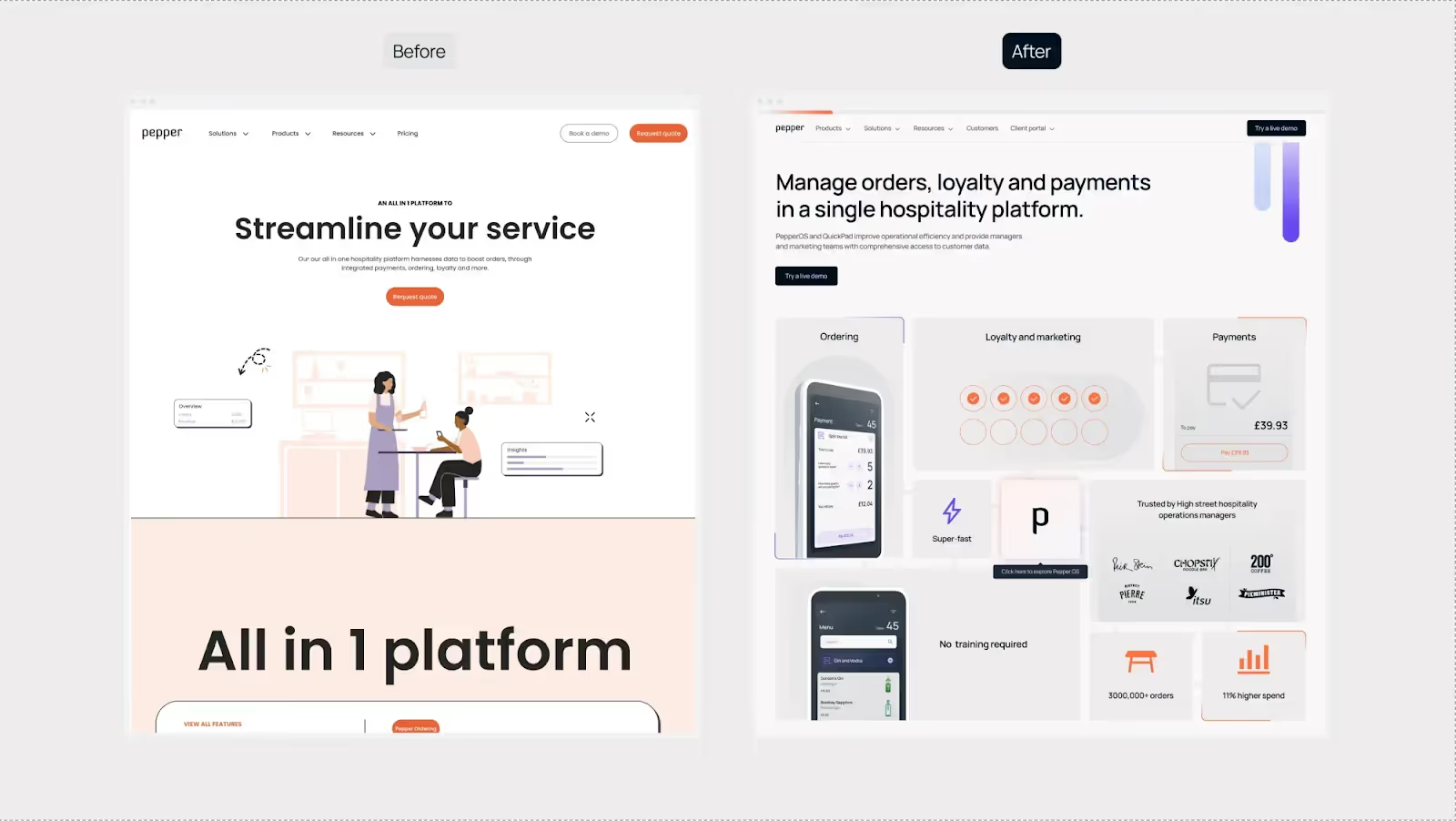
Before and After Brand Refresh for Pepper 2.0
Step 4: Craft a focused value proposition
Your unique value proposition (UVP) is the linchpin of your positioning. It explains, in plain language, why your ideal customer should choose you over the alternatives. Developing your own positioning statement is crucial, as it forms the foundation for all your messaging and helps differentiate your SaaS in a crowded market.
A simple SaaS‑friendly template, adapted from Geoffrey Moore, is:
“For [target customer] who [has this specific problem], [product] is the [category] that [key benefit and difference].”
For example, you might shift from “All‑in‑one HR platform” to “The HR ops cockpit for 50–500‑person remote‑first teams that want one place to run payroll, time off, and performance without hiring a bigger HR team.”
The second version tells you who it’s for, why it matters, and what success looks like. A compelling positioning statement like this can help your SaaS stand out by clearly highlighting the real-world outcomes and benefits for your customers. Keep your UVP:
- Specific: Avoid non-specific, vague or generalised fluff. Remember, a strong positioning statement is always tailored to a well-defined audience.
- Outcome‑driven: Lead with the transformation, not the feature.
- Short: One to two lines is enough; the rest belongs in your messaging framework. Make sure to effectively communicate your value proposition in a concise way.
Step 5: Turn positioning into a statement
A positioning statement is an internal North Star, not a tagline for your homepage. Creating a clear product positioning statement is crucial, as it forms the foundation for your marketing and product strategy. Its job is to align your team so design, copy, sales, and product all pull in the same direction.
A brand positioning statement serves as a strategic internal document that clearly articulates your product's target audience, primary value, market category, and key differentiators. This statement acts as an internal tool, guiding marketing strategies and ensuring operational coherence across teams.
Use a structured format that captures:
- Audience: Exactly who you serve.
- Problem and context: The situation they are in when they need you.
- Solution and category: What you are and how you fit in their mental “toolbox.”
- Key differentiator: The main reason to pick you over something else.
Workshop this with founders, product, and GTM—not just the design or marketing team—because this statement ultimately drives everything from roadmap priorities to campaign concepts and guides your marketing messaging.
UVP vs positioning vs messaging
Founders often use these terms interchangeably, which is how vague websites are born. Here’s how they differ and work together.
Once these are aligned, your visual identity and site design finally have something meaningful to express.
Step 6: Build a simple messaging framework
Before touching Figma, build a messaging skeleton so every surface tells the same story. Think of it as UX for your ideas. A lean SaaS messaging stack usually includes:
- Core promise: One headline‑level statement that captures your UVP in emotional, memorable language.
- 3–5 value pillars: The main benefits or outcomes customers care about, each backed by a concise explanation and a proof point (metric, feature, or story).
- Objection‑handling messages: Snappy answers to “Why not use X?” and “What if we just stay with our current setup?”.
Use this framework to create marketing materials—such as case studies, comparison pages, and promotional copy—that highlight your platform's features, benefits, and competitive advantages. Make sure your marketing efforts are aligned with your messaging framework to drive cohesive go-to-market strategies and effective customer engagement.
This framework becomes the source material for your homepage hierarchy, feature page content, pricing page messaging, and even product tour scripts. Consistent messaging across all touchpoints helps build a loyal customer base and distinguishes your SaaS from competitors.
Step 7: Translate positioning into design
Once your positioning is clear, design becomes execution—not exploration for its own sake. Visual identity and UX should amplify the perception you want, not fight it. For example:
- A pioneering, disruptive position might lean into bolder colour, asymmetry, and more provocative copy to signal a break with the status quo.
- A “safe pair of hands” enterprise position might emphasise clarity, calm layouts, and rigorous use of data and proof points, while also presenting your product as a premium offering through refined design elements and professional-grade visuals.
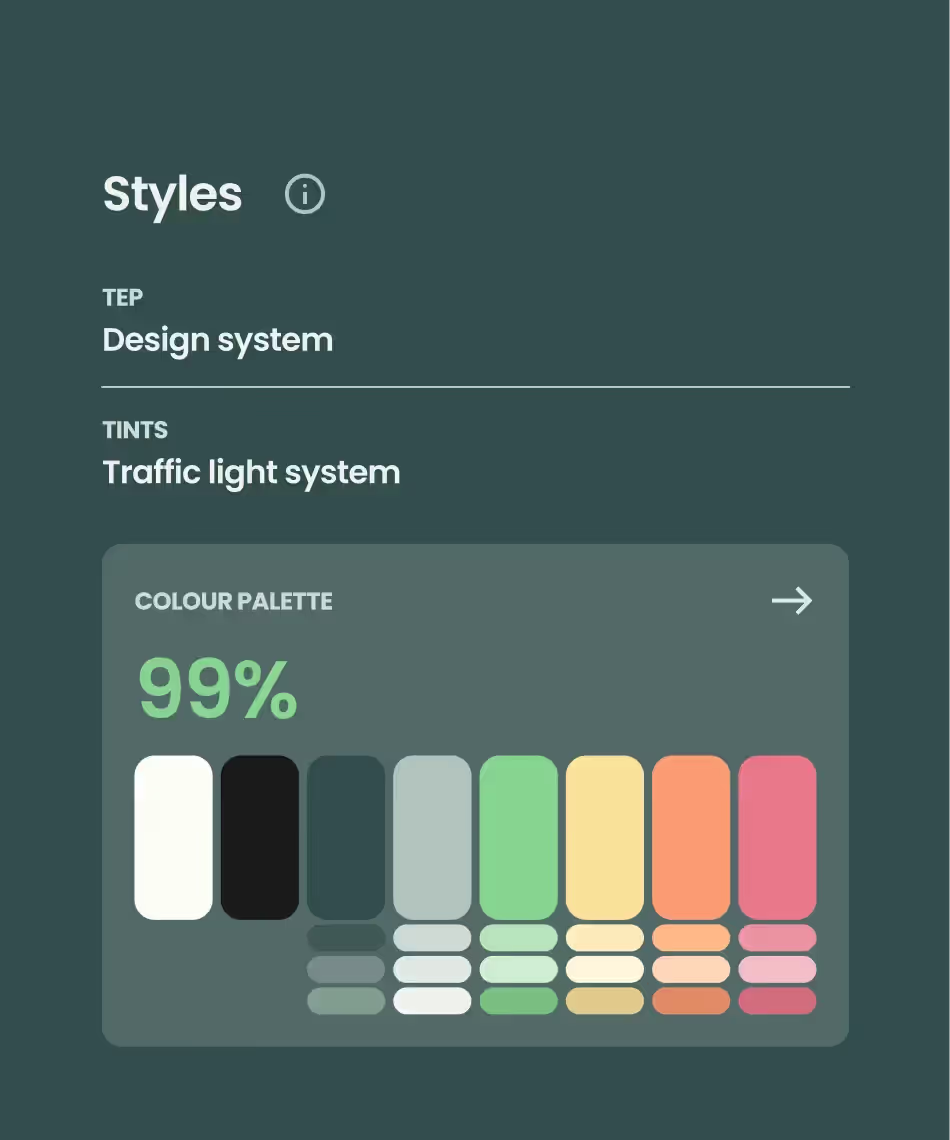
Your brand personality should be consistently reflected in your visual identity—whether that's through colour choices, typography, or imagery—to create a distinct and memorable impression.
Positioning your SaaS as a premium brand can be achieved by using sophisticated design choices, high-quality visuals, and attention to detail that signal quality and exclusivity.
The same goes for interaction design: microcopy, empty states, and onboarding flows can all reinforce your brand’s personality—reassuring, witty, buttoned‑up, or bravely opinionated.
Step 8: Pressure‑test with real humans
Positioning that only works in a Notion doc is a liability. Before you declare victory, test your new story in the wild. Use low‑risk channels:
- Customer interviews: Read your draft UVP and ask them what it means in their own words.
- Cold outbound and landing pages: A/B test new angles with specific segments to see what moves replies and sign‑ups.
- Sales calls: Listen for whether buyers repeat your language back to you unprompted.
- Gather feedback: Use surveys or interviews to gather feedback from customers and prospective customers, helping you validate and refine your positioning.
If they misinterpret your message or shrug, that’s not a “dumb user”; it’s a signal your positioning needs another iteration. Use customer feedback to identify gaps and iterate on your positioning until it resonates. Always test your messaging with prospective customers to ensure it connects with the audience most likely to convert.
Step 9: Operationalise your positioning
Positioning only works if it leaves the strategy doc and infiltrates the way your company behaves. Treat it as a living system, not a one‑time branding exercise. Bake it into your:
- Product roadmap: Prioritise features that strengthen your core position rather than chasing every customer request. Leverage a product growth platform to drive user engagement, improve onboarding, and track the impact of new features on overall product success.
- Sales enablement: Equip reps with messaging, case studies, and talk tracks that mirror your value pillars, and ensure alignment with customer success initiatives to create a unified customer experience.
- Website optimisation: Use CRO, heat mapping, and analytics to continually refine how clearly and quickly your positioning lands on‑site. Analyze customer interactions to further refine your messaging and product positioning.
Over time, this creates a feedback loop where positioning guides decisions, and performance data helps you sharpen the narrative. Clear positioning helps attract customers by differentiating your SaaS offering and building long-term trust.
Concerned about conversions? Grab a free website conversion audit
When to revisit your positioning
SaaS markets move constantly; your positioning should occasionally move with them. Revisit it when any of these happen:
- You move upmarket or downmarket.
- A new category emerges and suddenly you feel your identity is “blurry” again.
- Your best customers start using you for something different than you originally intended.
- There are changes in your pricing strategy or you need to adopt a pricing-based positioning approach, such as introducing tiered pricing for price sensitive customers or moving to a higher price point to target premium segments.
Shifting to a higher price point or focusing on price sensitive customers may require a new positioning strategy to ensure your brand continues to resonate with your target audience. Treat these moments as opportunities to clarify and re‑commit, not to blow everything up for the sake of novelty.
When founders front‑load this strategic work, everything downstream—brand identity, website, campaigns, even product naming—gets easier, faster, and more effective. You end up with a SaaS brand that feels inevitable to the right people, instead of one more “all‑in‑one platform” trying to shout over the crowd. Updating your positioning also helps you continue to attract potential customers as the market evolves.
Turn positioning strategy into reality with Overpass Pro Design
Once you've defined your positioning strategy, the real work begins: translating it into every customer touchpoint. This is where many SaaS teams hit a wall. They have the strategy doc, but lack the design capacity to execute it consistently across their website, sales decks, ads, and product marketing materials.
Overpass Pro SaaS Brand Design gives you instant access to an entire design team specializing in B2B SaaS for a fraction of the cost of hiring in-house. Our senior designers understand SaaS positioning instinctively, which means lighter briefs, faster turnaround, and no need to explain why your differentiation matters or how to translate value pillars into visual hierarchy.
- Flexible monthly resource: Scale design support from 30 to 190 hours per month based on workload, with the ability to pause or cancel anytime—perfect for launch sprints followed by steady optimization
- Full marketing stack: From website redesigns and landing pages to sales decks, paid ads, and email campaigns, we create all the materials your positioning needs to live in
- Senior B2B expertise: Work with designers who've spent years in the SaaS world and understand how to translate strategic positioning into conversion-focused design
- Managed workflow: A creative director oversees every project, ensuring brand consistency and that your positioning comes through clearly across all touchpoints
We start every engagement with a free design day trial, so you can test whether we grasp your positioning and execute it the way you envisioned.
Book a free brand design day
Get in touch