B2B Brand Storytelling: Why You Shop with Few Brands
Learn why B2B brand storytelling is essential for connecting with buyers, humanising your brand, and winning deals in a crowded market.

A story, told authentically, with meaning and purpose behind it, can't be copied. What's yours?
Think about the last five purchases you made. A coffee brand. A gym kit. A software subscription for your team. In each category, there were dozens of options at a similar price point. You didn't compare them all. You went back to the ones you already trusted, or chose the one whose name you'd heard before. Why?
The answer is not quality. It's not price. It's story.
Stories are at the very core of our human experience. The way you see the world and your place within it is determined by the stories you tell. A successful brand exists in very much the same way. We make purchase decisions not on a careful evaluation of pros and cons, but as a reaction to the stories that brands tell us. The brands we buy from repeatedly are the ones whose story we've absorbed, believed, and made part of our own identity.
Most people assume this is a consumer phenomenon. It isn't. The same mechanism that makes you loyal to a coffee brand is the one that makes a VP of Sales recommend the same CRM three jobs in a row. B2B buyers are not different people. They are the same people, making decisions with the same brains, shaped by the same stories, just in a meeting room instead of a checkout queue.
And yet, the vast majority of B2B and SaaS brands write as though their buyers are spreadsheets. Feature lists. Pricing tiers. ROI calculators. All of it designed to appeal to a rational decision-maker who, in reality, does not exist.
Free website audit | Book a call
The Rational B2B Buyer Is a Myth
Here is the uncomfortable truth that most B2B brand design and storytelling ignores: the person approving your SaaS contract at 3pm has exactly the same brain as the person buying Patagonia at the weekend.
Research by Bain & Company found that B2B purchase decisions are significantly influenced by personal emotional factors (career risk, reputation, peer approval) more than any feature checklist or ROI calculation. The average B2B buying committee involves 6 to 10 stakeholders and a decision cycle that stretches 6 to 18 months. That's a long time for a weak brand story to survive a series of forwarded emails and a board sign-off.
The B2B brands that understand this are the ones pulling away from the field.
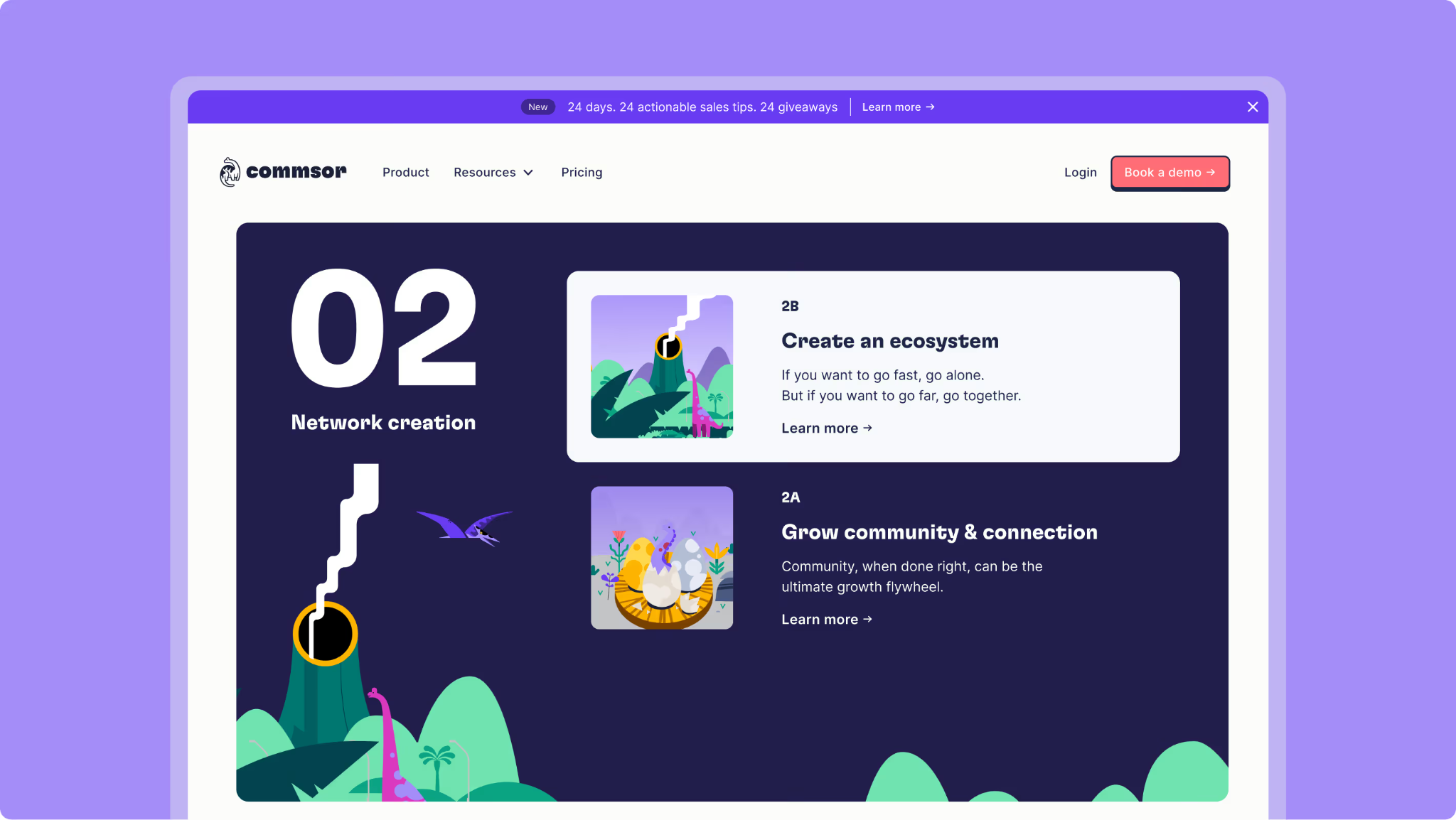
Take Commsor. On the surface, they built a Go-to-Network platform (software that maps your company's contacts and surfaces warm introduction routes to prospects). That is the product. But Commsor never led with it. Their brand was built around something else entirely: the belief that relationships, not cold emails, are how B2B growth actually works.
That was their most effective brand decision: stop talking about the platform.
They knew five other tools could make the same feature claims. So instead, they built an identity that felt nothing like enterprise SaaS: warm, playful, drawing visual inspiration from retro video games and science fiction. When we worked with the Commsor team to evolve their website to match that ambition, Mac Reddin, Founder, told us: "Our CMO described it like someone truly knew our brand and had found the right ways to improve it."
You could describe Commsor as a B2B network intelligence platform. Or you could describe them as the company that believes cold outreach is broken, and they just happen to have built the tool to prove it. Only one of those descriptions travels through a buying committee.
Know What You Stand For So That You Can Stand Out
Caide and Punch! both operate in B2B sales. Both help companies generate pipeline. Put their feature sets side by side and the overlap is considerable.
Browse their brands and you find two entirely different stories.
Caide is the AI campaign manager built to be your guide. We built their identity around a mascot (a dog named Caide) embodying the idea of a companion at your side through every outreach campaign. The visual language is warm, adventure-led, and playful. Seb Vissers, Founder, told us after going through our Brand ID Workshop: "The final result exceeded our expectations." The story Caide tells is that selling should feel like an adventure, not a grind.
Punch! is built for companies who want to dominate. A tech-enabled sales agency that generated over $1 billion in pipeline in 12 months, their brand leads with confidence and scale. Bold gradients. A future-facing visual identity. Performance metrics front and centre. The story Punch! tells is that if you are serious about results at enterprise scale, this is the team you call.
Two companies in the same market. Two wildly different stories. Neither leads with a feature. The pattern applies across every B2B category: where ten platforms claim to do the same thing, the brand with the clearest story is the one that reaches the shortlist.
What Storytelling Means When Your Buyer Is a Committee, Not a Person
B2C brands tell a story to one person at a time. In B2B, your story has to survive a procurement email chain.
We've worked with over 50 B2B SaaS and technology brands across the US and UK over 7 years. Time and again, the companies that struggle to close deals are not the ones with inferior products. They're the ones whose brand story cannot be retold. Their champion in the buying committee can't articulate what makes them different in a Friday afternoon Slack message to the CFO. Their website looks like every competitor's. Their story has no spine.
One client that illustrates this precisely is Topanga. Founded in Los Angeles in 2021, Topanga had built genuinely revolutionary AI-powered food waste management technology. They were trusted by over 90 dining programs across the US and had secured an $8 million Series A funding round. The technology was exceptional. The brand was not. It looked and communicated like every other green tech startup: sustainability claims without a story, product features without a belief.
Hayley Bance, VP of Experience and Design at Topanga, came to us looking for a fresh identity to better reflect Topanga's position in an ever-changing food-service industry. In our Brand ID Workshop (the structured session we run at the start of every brand engagement to surface core beliefs and positioning) the Topanga team uncovered something precise: their technology doesn't replace the chef. It serves them. That one idea changed everything.
We redesigned their identity around that belief. An updated colour palette, a new visual language for their product suite, and a set of graphic expressions that brought the intelligence behind the platform to life, without making it feel cold or robotic. The result, in Hayley's words: "a brand and digital presence that feels modern, cohesive, and authentic. The end result exceeded our expectations."
That's what a story does. It gives your champion something to carry into the room.
Free website audit | Book a call
The Brand Story Stack: Before and After
Across the B2B brands we've worked with, the shift from commodity to distinctive always follows the same pattern: from feature claim to core belief, from generic to irreplicable.
Finding Your B2B Brand Story
Brands can no longer afford to be faceless, storyless organisations. They must become their own personalities and engage with customers on a regular basis. As the internet democratises marketing, human attention is at an increasing premium.
We no longer wish to feel like the consumers at the end of the supply chain but instead, part of a brand's story. We're on the search for communities and movements we can get behind and feel good about supporting. Coming up with a story that caters to these needs is the central challenge facing brands today.
Lima Delta is a strategic learning design agency that builds blended digital learning experiences for global brands including DAZN, HSBC, and John Lewis. Before we worked together, their value was real and their client list was impressive. But their brand looked and sounded like every other L&D consultancy. Uniqueness was buried in industry jargon.
Through our Brand ID sprints, we found the belief at the centre of their work: learning should be tangible, hands-on, and human. The identity we built drew from the design language of Dieter Rams. His famous switches and dials became graphic metaphors for interactive, hands-on learning. Less is more. A philosophy that made the abstract concrete and gave Lima Delta something no competitor could copy.
Georgina Cooke, Director, told us: "Our initial conversations about brand identity were invaluable. You truly listened and helped us define our business values. The outcome is unparalleled, perfectly timing our company's next growth phase."
That is what a story does in B2B. It makes the invisible visible. Once Lima Delta could articulate what made them different, every prospect conversation changed. It was obvious. It was honest. It was theirs.
Great B2B brands find their "Why", their core values, the reason they get out of bed in the morning, and they shout it from the rooftops.
You see, a story, told authentically, with a meaning and a purpose behind it, can't be copied. You don't need the best product on the market. You need people to believe in your vision, to see something in your story that they see in themselves.
And in B2B, where your story has to survive six touchpoints, two procurement rounds, and a CFO's gut check, a distinctive brand is not a nice-to-have. It's the difference between winning the deal and being a line item on a comparison sheet.
Work With Overpass
At Overpass, we work closely with B2B SaaS and technology brands to identify core values and build them into brand narratives, website designs and branded assets that convert buying committees, not just individual buyers.
Over 7 years and 50+ engagements, we've seen what happens when a B2B brand gets its story right: SaaSrise saw a 24% improvement in visitor-to-lead conversion after we rebuilt their website around a clearer brand message (from 3.16% to 3.92%).
If your brand story can't survive a forwarded email, it's time to find one that can.
Start with a call
B2B SaaS brand storytelling FAQs
Why is brand storytelling important for B2B SaaS companies?
B2B SaaS brand storytelling matters because it creates emotional connections that feature lists cannot. Research shows emotionally connected customers are 52% more valuable to a company and in a market where ten platforms claim the same capabilities, a compelling brand story is what makes yours the one that gets remembered. It's not a nice-to-have layer on top of your marketing strategy. It is the strategy.
What makes a compelling story for a B2B brand?
A good brand story starts with a specific belief, not a product description. It reflects the brand's values clearly enough that your target audience can see themselves in it, and authentic stories do this far better than polished copy because buyers can feel the difference. The brands that build lasting brand identity are the ones whose core narrative is precise enough to survive retelling without losing its meaning.
How does brand storytelling work when you're selling to a committee, not a person?
When your audience is a buying committee of six to ten people, your brand narrative has to travel without you. A cohesive narrative across your website, sales deck, and social media means every stakeholder encounters the same message and your internal champion can articulate what you stand for without the deck in front of them. Brand credibility is built in the gaps between meetings, through the story your buyer tells on your behalf.
Should B2B SaaS brands use the customer as the hero of their storytelling?
Yes. Customer as hero storytelling is one of the most effective shifts a B2B brand can make. It means your product is the guide, not the protagonist; customer success stories show transformation, not features. Real customer stories are your most powerful marketing tool because they make the outcome tangible for the next buyer facing the same problem, and they build brand loyalty in a market where trust is the hardest thing to earn.
What's the difference between having a brand story and having a marketing strategy?
A marketing strategy tells you where and how to reach people. A brand storytelling strategy tells you what you stand for and that comes first. Without it, your marketing efforts produce noise: consistent spend, inconsistent message. When a brand stands for something precise, every sales conversation, every campaign, every piece of content pulls in the same direction.
Get in touch