.webp)
AI is not your new hire, it's your new infrastructure. Here's what that means for SaaS…
AI isn't your new hire, it's infrastructure. Here's what that means for SaaS leaders using it to compete.

When OpenAI launched ChatGPT in November 2022, it reached 100 million users in two months. That's a record TikTok took nine months to hit, and Instagram two and a half years. Three and a half years on, the conversation has moved past "what is this thing?" and into something that matters more for B2B software leaders: what does running a SaaS business in an AI-native world actually require of you?
This isn't a primer. You've heard the pitch. What follows is an honest look at where AI is creating genuine competitive leverage in SaaS, where it's quietly creating risk, and why the businesses getting the most out of it aren't the ones using it everywhere. They're the ones being deliberate about exactly where it belongs.
How far has AI actually come since 2022?
The version of ChatGPT that launched in late 2022 was built on GPT-3.5. Impressive for its time, but essentially very fluent autocomplete. What's available to SaaS teams today is a fundamentally different thing.
The key developments:
- GPT-4 (March 2023): The first genuinely multimodal model. 40% more accurate than its predecessor, 82% less likely to produce harmful outputs, and the first model businesses could credibly consider for production use.
- GPT-4o (May 2024): OpenAI's "omni" model, processing text, audio, and vision in real time at roughly half the cost of GPT-4 Turbo.
- The "o" reasoning series (late 2024–2025): Models that spend more time reasoning before answering. Coding benchmark scores roughly doubled between GPT-4o in mid-2024 and the best reasoning models by the end of 2025.
- GPT-5 (August 2025): A 256,000-token context window and materially stronger performance on complex tasks.
- GPT-5.5 (April 2026): The current OpenAI default, reporting 52.5% fewer hallucinated claims than its predecessor and 23% greater factual accuracy on flagged conversations.
By May 2026, ChatGPT had crossed 1 billion monthly active app users, the fastest any app in history has reached that milestone. OpenAI's figures put weekly active users at 900 million as of February 2026. Gemini sits at 662 million monthly users and Claude at 245 million, though Claude's year-on-year growth rate of 640% far exceeds ChatGPT's 62%.
On the enterprise side, 64% of organisations now report using AI in at least one production workload, up from around 50% eighteen months ago. This is no longer a tool people are evaluating. It's infrastructure.
Is ChatGPT a SaaS?
Technically, yes. But for B2B leaders, the more useful question is what kind. ChatGPT and the broader class of AI platforms it belongs to are best understood as an intelligence layer that other products, workflows, and SaaS platforms are increasingly being built on top of. Over 60% of SaaS providers have now integrated AI into their platforms in some form, and that number keeps rising.
What this actually means for SaaS companies
Most AI coverage frames it as a productivity tool. For SaaS businesses, the implications are more structural. This is a shift in what software is expected to do, and how companies compete on the back of it.
Your product is probably already AI-powered, or your competitors' is.
Wix integrated OpenAI to build an AI website builder where users describe their business and receive a complete site. Framer followed with AI-native design tools. Microsoft's investment in OpenAI now runs through Copilot, embedded across the Office 365 stack that most enterprise buyers already use daily.
Beyond productivity tooling, AI agents are beginning to reshape how SaaS products work at a more fundamental level. Where traditional SaaS required humans to navigate interfaces and trigger workflows, agentic AI can plan, execute, and iterate across multi-step tasks without intervention at each step. Sales automation, support, and marketing functions are already being handled this way at scale.
This is the context your go-to-market team is operating in. Buyers' expectations of what "intelligent" looks like inside software have moved significantly. Features that were differentiators two years ago are table stakes now, and so many SaaS websites look and sound identical because the messaging has converged accordingly.
The part of the AI story most leaders are telling wrong
Here is where we have a strong view, and it matters for how you approach AI across your business.
AI is very good at lowering the barrier to entry. It allows you to generate generic output quickly. That has real uses in specific places. But "quickly generating generic output" is not a strategy, it's a template machine that everyone has access to simultaneously.
Companies always had the option to buy templates. Most good marketing teams chose not to, because standing out is the job. Distinctness has commercial value. When every competitor has access to the same generation tools and is generating from the same pool of training data, the output tends to look and sound the same. That's just how this technology works.
The problem we see most acutely in our own work is this: roughly 90% of client briefs now arrive generated by AI. When those briefs go unquestioned, when no one with industry experience pushes back on what's been assumed or missed, the design and strategy that follows is set up to fail before it's begun. AI can produce a brief that sounds credible and thorough. It cannot tell you what's actually wrong with it. That requires judgment, experience, and context that comes from the industry, not from a model.
Leaders are asking more of their marketing teams. Marketing teams are using AI to meet those demands. Designers receive briefs that look complete and build directly from them. But if the thinking behind the brief is generic, the output will be too, no matter how skilled the person executing it.
Our position on this is straightforward: AI is for specific implementation and development tasks. It is not for thinking, and it is not for creating.
Where AI does and doesn't belong in your process
That isn't an anti-AI argument. It's a precision argument. The distinction matters practically.
Where AI should be in your process:
Once you have done the strategic and creative work with actual human judgment, AI can and should be used to accelerate the development and implementation that follows. In the context of website and product work, this is significant. Webflow, for example, allows you to connect Claude directly to the development pipeline, compressing the time between design decisions and live build considerably. That is a genuine efficiency gain. It speeds up real work without replacing the thinking that determines what gets built.
Where AI should not be in your process:
Strategy. Brand positioning. Design direction. These are the places where distinctness is created, and they are exactly the places where AI produces the most interchangeable output. A model trained on everything produces regression to the mean. That is useful for many tasks. It is actively counterproductive when the goal is to stand out.
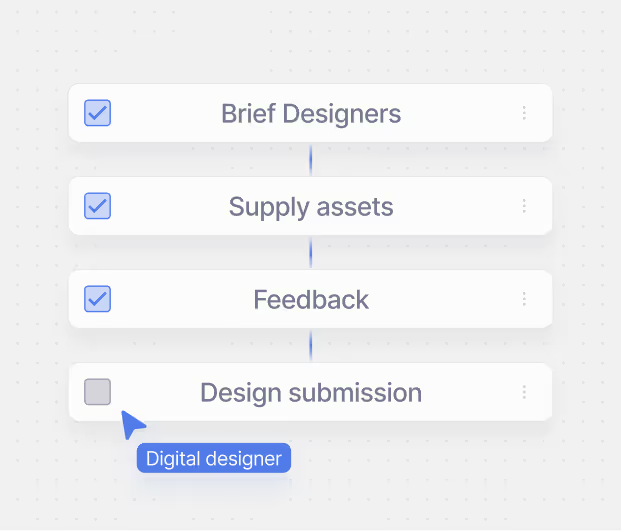
The specific sequence matters: human creativity first, to develop genuine strategy and design that reflects a real point of view; then AI to accelerate the development and execution of that work. Reversing that sequence, using AI to generate the thinking and then having humans execute it, is where generic results come from.
The risk side that most leaders underestimate
47% of enterprise leaders have made at least one major business decision based on unverified AI output. These are not naive experimenters. These are professionals running AI in production. The underlying problem is that models generate confident, plausible-sounding content that is sometimes simply wrong, and the problem is not uniformly distributed.
On general knowledge queries, the best current models hallucinate at under 1%. That number looks different with domain specificity:
For high-stakes outputs, a useful framing is that AI handles the first 30% of a workflow: the pattern recognition, the drafting, the surface-level analysis. The humans governing the rest of the process are what determine whether the output is actually reliable. The 47% statistic above is what happens when that layer is absent.
76% of enterprises have now introduced human-in-the-loop processes specifically to catch AI errors before they reach production. 90% of software executives are optimistic about AI's impact, but the optimism is increasingly qualified. The edge goes to businesses that use AI well, not businesses that simply use it.
What this looks like for SaaS teams in practice
The SaaS teams generating real returns from AI are using it as a velocity multiplier for skilled humans, not a replacement for them.
- Content and brand: AI can draft at scale. A skilled writer or strategist shapes, edits, and evaluates for accuracy, nuance, and whether it sounds like the brand at all. The output quality ceiling is set by whoever is reviewing, not whoever prompted it. Understanding and maintaining your brand voice matters more in an AI-assisted world than it did before, because without the editorial layer, the default is to flatten everything into the same register. That register is recognisable, and not flatteringly so.
- Website and design: AI tools can accelerate iteration. But conversion-focused B2B SaaS websites require an understanding of buyer psychology, ICP clarity, and offer positioning that no model reliably produces from a prompt alone. The copy choices that actually drive conversions are judgment calls. AI-generated sites have a recognisable aesthetic, and not in a good way. The layouts are competent in the same way they all are: templated, interchangeable, and immediately identifiable. Buyers notice. When a site looks machine-made, it erodes trust before a single word of copy has landed.
- Positioning and messaging: This is the work most directly responsible for pipeline in sales-led SaaS. Strong SaaS brand positioning requires synthesis across customer conversations, competitive context, and market understanding that AI can support but cannot lead.
- Customer support and retention: AI-powered support tools can forecast churn, flag at-risk accounts, and handle front-line inquiries well. Used to augment customer success teams rather than replace them, this is where businesses typically see the strongest return on AI investment.
- Decision-making at scale: AI can process data at a volume no human team can match. But the quality of what it surfaces depends entirely on the quality of the data it works with, the governance around the models, and the clarity of the question being asked. Data-driven decisions based on AI output alone, without a validation layer, are where the 47% statistic originates.
Will AI be the end of SaaS?
No. But it will be the end of a certain kind of SaaS. The businesses that face the sharpest pressure are those built on shallow differentiation: single-purpose workflow tools, basic reporting dashboards, point solutions that capture data but don't act on it. What survives and compounds is SaaS built on deep customer relationships, proprietary data, and genuine workflow integration, where AI embedded at the product level creates switching costs that can't be easily replicated.
AI integration can drive a 4–6x increase in revenue multiples for SaaS products that get this right. SaaS products that treat AI as a surface feature risk commoditisation.
What this means for your website and your pipeline
For B2B SaaS companies, the website is where AI risk and AI opportunity intersect most visibly. AI tools can generate a homepage in minutes. A homepage that actually converts sales-qualified leads requires something that can't be prompted into existence.
It requires clarity of offer. A defined ICP. A value proposition that speaks to a specific buyer's specific problem, not a polished version of a general one. Getting your homepage headlines right is consistently where AI-generated first drafts fall shortest.
The same applies to design. In a market where AI is producing more generic-looking competition every day, a design that is genuinely distinct has never been more commercially valuable. Standing out is not an aesthetic preference. It is a business result.
At Overpass Studio, we work exclusively with B2B SaaS companies on this, and we see firsthand where AI-generated sites fall short. The prose is often clean. The layout is often competent. But the strategic thinking that makes a visitor say "this is exactly for me," and the visual identity that makes them trust you enough to stay, is consistently missing.
That's why we pair deep SaaS positioning expertise with our design and Webflow development work. If you're curious what's costing your current site conversions, our free B2B SaaS homepage audit identifies the specific clarity and conversion opportunities unique to your site, with no obligation.
The practical question for SaaS leaders
AI is not a competitor to your team. It's infrastructure, and like any infrastructure, it performs best when it has been deliberately designed, properly governed, and operated by people who know what good looks like.
The businesses most at risk from AI are not the ones ignoring it. They're the ones using it in the wrong places: outsourcing strategy to it, prompting briefs through it, having design direction emerge from it, and then wondering why nothing they produce feels distinct.
The question is not whether to use AI. The question is whether you're clear about where it belongs in your process. Used in implementation and development, it can compress timelines significantly and deliver real efficiency. Used as a substitute for thinking, it produces the same output as every other company running the same prompts. And in a market where distinctness is the job, that's not a competitive edge. It's a liability dressed up as productivity.
If you're a sales-led SaaS company thinking through how AI intersects with your website, your positioning, or your brand, we'd be glad to talk.
Overpass Studio is a B2B SaaS website and branding agency. We design, build, and optimise high-converting websites for sales-led software companies. Explore our services or request your free hero redesign.
Get in touch