How To Find Your SaaS Brand Voice and Master Your Tone
Looking for practical advice on how to speak to your audience? Try these four steps.

Just as you’d recognise a friend’s voice across a crowded room, your audience should be able to identify your brand through your use of language. In this document, we’re letting you into our process and uncovering the exercises we use to move from initial client conversations to a completed set of “Brand Tone & Voice Guidelines”.
The aim is simple, whether you’re the founder of the business or the summer intern, you’ll have a document which guides your messaging, retains consistency and ensures authenticity across the board. But where do you start?
Your SaaS brand voice is the consistent personality expressed in every piece of communication your company produces, and mastering it requires a documented framework that any team member can apply without a briefing call. Companies that leave voice undefined produce content that sounds like a committee: technically accurate, stylistically inconsistent, and memorable to no one.
Take Slack, for example. Slack's brand voice ("clear, direct, witty, and human") is not a style preference: it is a competitive differentiator documented in a brand guideline that every writer, designer, and customer support agent at Slack has access to. That consistency at scale is the output of a voice and tone process, not individual talent.
For B2B SaaS companies in particular, where the buying cycle is long and involves multiple stakeholders reading multiple touchpoints, a consistent voice is a trust signal. A prospect who reads your LinkedIn post, your sales deck, and your support documentation and finds the same voice in all three experiences a coherent brand. A prospect who finds three different registers in those three contexts is experiencing a brand that has not resolved its identity.
This article covers:
- What brand voice is and how it differs from tone
- Why brand voice matters more than most SaaS companies realise
- A four-step process to develop your SaaS brand voice
- Whether and how to update your brand voice as your company grows
Why Brand Voice Matters for SaaS Companies
Brand recognition does not come from logos alone. Research shows that consistent brand presentation across all channels can increase revenue by 23 to 33 percent and yet 60% of marketing materials fail to conform to brand voice guidelines.
That gap between intention and execution is exactly what a documented voice framework closes. For SaaS companies specifically, brand voice matters because it builds trust across the entire buying journey. Your visual identity gets a prospect to stop scrolling. Your brand voice is what keeps them reading, converts them from curious to convinced, and reassures them through onboarding and support.
When the voice shifts between your website, your emails, and your chat widget, it creates a subliminal sense of incoherence, the digital equivalent of meeting three different people at the same company on three successive calls.
Building trust in B2B SaaS is a long game. A strong brand voice humanises technical services, making abstract capabilities feel approachable and the company behind them feel credible. It is also a differentiator: in markets where competing products are functionally similar, a distinctive verbal identity is one of the few things a competitor cannot copy overnight.
There is a further, newer pressure on brand voice consistency: 85% of marketers now use AI writing tools for content production. Without a documented brand voice that can be used to prompt and evaluate AI-generated content, AI tools default to the most generic, median register available, which is to say, the voice of no one in particular. A clear voice framework is what makes AI a useful tool rather than a consistency risk.
What Is Brand Voice in SaaS and How Is It Different From Tone?
Brand voice is the fixed personality of a brand: the set of character traits that remain constant across every communication regardless of audience, channel, or context. Tone is how that personality adapts to a specific situation. Monzo’s voice is conversational, direct, and human. That voice does not change between a product marketing page and a fraud alert notification. The tone of the fraud alert is more urgent and less playful than the product page, but the underlying voice (accessible, non-jargon, human) is consistent.
The distinction matters practically because it defines what changes and what does not. Voice does not change. Tone changes constantly. A brand that has documented only its tone produces content that feels inconsistent because the writers have no fixed reference point beneath the situational adjustments.
For B2B SaaS brands specifically, the most common voice errors are:
- Defaulting to enterprise register (formal, impersonal, passive) when the product is positioned as accessible
- Defaulting to startup informality (emoji, slang, hyperbole) when the buyer is a senior enterprise decision-maker.
A well-defined brand voice eliminates this guesswork.
What Is the Difference Between Tone of Voice Sliders and Brand Archetypes?
Tone of voice sliders position a brand on a spectrum between opposite qualities (formal vs. casual, serious vs. playful, technical vs. accessible) and produce a calibration tool writers can apply to specific contexts. Brand archetypes, drawn from Carl Jung's 12 personality frameworks, provide a characterisation shortcut: the brand is the Sage (knowledge-based authority), the Explorer (pioneering, boundary-pushing), the Creator (imaginative, expressive), or one of nine other archetypes. Each archetype carries an implied vocabulary, a characteristic sentence rhythm, and a predictable emotional relationship with the audience.
The two frameworks serve different purposes. Sliders are a calibration tool: they tell a writer whether to write "we understand" or "we get it" in a specific context. Archetypes are a characterisation tool: they tell the team what personality the brand is playing before the slider calibrations begin.
The most effective brand voice documents use both. Mailchimp's brand guide uses the "witty but not wacky, direct but not harsh" framework (slider logic) within a personality characterisation built around genuine, inclusive, and curious (archetype attributes). The combination gives writers both the personality to inhabit and the calibration for each specific content type.
Brand Voice Examples: What Strong SaaS Voices Look Like in Practice
Before building your own framework, it helps to study how the best-in-class do it. The following SaaS brand voices are worth examining not just because they are distinctive, but because each one is doing a specific job for a specific audience.
Creativity Is the Aim, Teamwork Is the Game
The first thing you should know about creating your brand voice is this — don’t attempt it alone. Not only is it maddening to stare at a page full of words and wonder which fits your brand, but you’ll never have the brainpower to match a group working creatively together.
Where some of your team might work best testing ideas in a group dynamic, others may need their own space to find their creative peak. Having a mixture of individual tasks and group challenges is a great way to cater to all personality types. Keep in mind that your job isn’t to have all the right answers, but to provide the environment, questions and prompts which help your team create magic.
How To Develop Your SaaS Brand Voice: A Four-Step Process
Step one: auditing your existing voice
Start by reading 20 to 30 pieces of your existing content across different channels and documenting the vocabulary, sentence length, point of view, and register you actually use, not the one you intend to use. Most B2B SaaS companies discover significant inconsistency in this audit: website copy in one register, sales emails in another, social content in a third. The audit makes this visible before the voice-building work begins.
Look at the competition (1-2 hours)
To successfully carve your niche in the market, you need to know who is already out there and how they are communicating. We think it’s the best place to start, you certainly don’t want to spend hours crafting language that turns out to be very similar to others in your space. We do this by googling the industry and taking screenshots from the website of competitors and brands with interesting language.
As you work through these with your team, pick out the language you think works and the language you don’t like. Ask yourself: what is it about the way “Brand X” is communicating that we like? We recommend spending a good amount of time on this, looking in depth at five or ten different brands.
Look at yourself (1 hour)
Now you know what’s out there, turn your eyes back to your own messaging. Where do you sit in relation to your competition? Is there language you think works well? Ask yourself: does it reflect our core values, our proposition and speak to our audience in an authentic and engaging way?
Create a market landscape diagram (30 mins)
Most industries tend towards a few methods of communication. The below example showcases how several technology companies might vary in their messaging. Create a similar diagram and populate it with your competitors, where you currently sit amongst them and where you would like to be.

Look to the best (30 mins)
Before you look at writing some of your own copy, it’s a great idea to look at how the best do it. We’re not the only ones sharing our secrets – in recent years several successful enterprises have published brand voice guidelines. Here are some of our favourites.
Ask your team to write down what it is that makes their favourite brands speak to them. Is it a compelling call to action, an amazing founders' story, a sustainability-first practice or something else?
Step two: Define Your Voice Traits
Choose 3 to 4 voice traits and define each one with a positive statement, a negative contrast, and a written example. “Clear” is a voice trait. “Clear, not jargon-heavy” is more useful. “Clear, not jargon-heavy: write ‘we send your payment in 1 working day’ not ‘our payment processing pipeline delivers next-business-day settlement’” is a voice trait that a writer can apply without ambiguity.
The specificity of the contrast and example is what separates a usable voice guide from a decorative one. Five exercises reliably surface genuine voice traits rather than aspired-to ones:
Whether you're J.R.R. Tolkien or Joe Bloggs, a blank page can be really daunting. It’s why we start with a few exercises to get ink on the page and the creativity flowing. Here are five of our favourites…
Brand personality traits (20 mins)
These are human characteristics that you associate with your brand to help guide its voice. It’s a good idea to think of two or three of these traits to work from. You want to pick traits that feel obvious and right to your brand, but keep you in your own lane. The market isn’t kind to copycats.

Brand likeness (20 mins)
If you’re a little lost on traits it can help to liken your brand to someone you know. Would you say you’re more Micheal Schumacher or Michael McIntyre? It might sound silly, but having someone in the back of your mind will bring you back to the tone you're looking to strike.
Brand archetypes (20 mins)
Swiss psychiatrist and psychoanalyst Carl Jung gave us twelve character archetypes. It’s another way to reflect on how you see your brand. Ask which feels most aligned with your purpose. Maybe you’re ‘The Rebel’, ‘The Hero’ or ‘The Magician’…
This not that (30 mins)
This one’s all about the specifics — about getting into the details of what your brand's personality is. The aim isn’t to pick opposites or things that are obviously undesirable, but things you might get confused between. It takes the form of “we’re X but not Y” and is best described with some examples…
- We’re fierce but not feisty.
- We’re formal but not serious.
- We’re rebellious but not extreme.
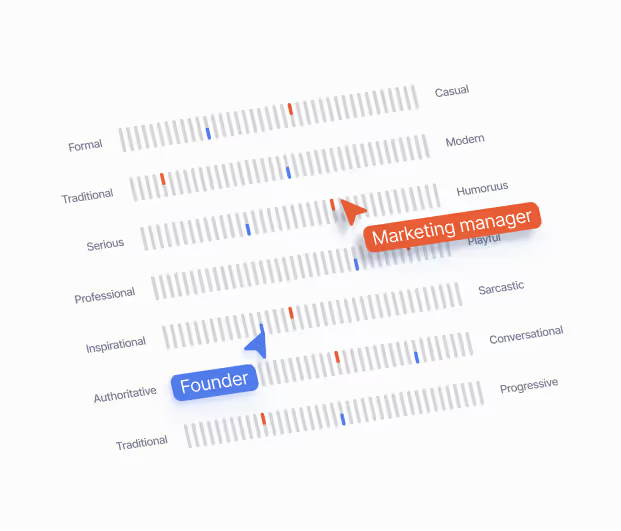
Language sliders
A little like No.4, language sliders look to get specific. You want to pick two categories and place yourself somewhere between them. Do you sway more towards formal or causal language? Are you more Avante-Garde or traditional?

Step three: write your style guide
A style guide translates voice traits into specific, actionable writing rules. It covers: point of view (first person plural “we”, second person “you”, or third person), stance on industry jargon (define once and avoid, avoid entirely, or use with explanation), emoji usage (never, only in specific channels, always with restraint), and preferred phrasing for common B2B SaaS contexts (onboarding, support, pricing, crisis communication).
So we’ve worked to identify where we sit in the market and where we’re aiming. Now we can begin to shape our brand guidelines document and provide the reader with a one-stop-shop for your brand tone and voice.
Tone of voice pillars
Here you’re after three or four words which both describe the tone you’re looking to strike and hold the values your brand instils.
Perhaps it’s: Knowledgeable | Caring | Trustworthy.
Or maybe it’s: Rebellious | Confident | Positive.
When you’ve settled on three or four words, write a paragraph exploring what each means for your tone. The idea is to explain why the pillar works towards your overall brand strategy and the language nuances you might come across when using it. Three sentences on each should do the trick.
Here’s what we might write for Rebellious.
“We’re bold in our pursuits, going against the grain to teach and preach all things diversity in a sector that’s due a glow-up. It’s not outright anarchy, but we know what we want, and we’re not here to be pushed around. It’s fearless and feisty but never aggressive and should always come with a pinch of humour.”
Style guide
You can see the style guide like a language FAQ. It serves to make sure that your employees have no 50/50 scenarios when writing that could lead your messaging estray. We feel it’s important to consider the following.
- Point of view — do you talk to your audience in the first or third person?
- Emojis — how “down with the kids” do you want to be?
- Jargon — do you use specific terminology or more inclusive language?
- Slang — how playful are you?
- Abbreviations — do you refer to it as Instagram or ‘the gram’?
- Preferred language — do you use “clients” or “customers”?
- Avoided language — swear words are an obvious example but it might be more nuanced.
Do’s & don'ts
Your job here is to give the reader a clear indication of style and tone in a number of different circumstances. These will obviously vary based on industry, customer base and business type but a few of the following are a good port of call. It’s a case of the more the merrier — we aim for five to ten.
- Social media captions.
- Press release.
- Email response to a customer.
- Email approach to a new client.
- Website copy.
- Email newsletter.
- Product description.
- Service description.
If you were a recruitment agency looking to congratulate someone on a new job it might go something like this…
Do: “Is that the pop of champagne we hear? 💃”
Don’t: “Congratulations on your new job!”
The style guide section that produces the most value in practice is the “do and do not” examples by content type. A sales email has different constraints from a blog post, which has different constraints from a push notification.
Specifying the voice application for each context removes the most common source of inconsistency: a writer defaulting to their personal register when they run out of brand guidance.
Step four: Embed the Voice in Your Production Process
Don’t worry, you’ve done the hardest part. Stage four is where you see the hard work turn into magic. Here are some tips to ensure your tone sticks.
A brand voice document that exists only as a PDF produces no behaviour change. The document needs to be embedded in the places where content is actually produced: brief templates, content design subscription dashboards, new hire onboarding, and creative review checklists.
Start with it
You can’t expect a new hire to nail your voice out of the gate so lean on your guidelines. Make them part of your training and get new hires to write some practice copy.
Print it
We live in a world of 0’s and 1’s, yet there’s still something to be said for a “hard copy”. So print it and stick it up around the office. A trip to the copier isn’t a glamorous way to spend an hour, but whether it’s a sales assistant or the CEO, a printed guide can only have positive outcomes.
Practice it
It’s important to remember where we started — your values and purpose. These began to formulate the way you speak on the page, now it’s time to talk that way and embed it into your culture. Nothing beats practice and internal communications are a great place to start. Whether it’s a chat over coffee or email, ask your team to keep your guidelines in mind.
Go back to it
Nothing is concrete, the world might change, your customers might change and you might change. It’s important to revisit your guidelines and adapt to the shifts around you. We advise going back to them before any major marketing decision or at the very least setting a date a year down the line to check your tone.
At Overpass Studio, voice and tone alignment is part of every content design engagement. We build voice criteria into the brief template so that every asset produced by the design team is checked against the brand voice before it reaches the client for review.
This removes the most common revision cycle: a design brief is technically complete but uses vocabulary or a register that the brand guide does not support.
Should You Update Your SaaS Brand Voice As the Company Grows?
No: the core voice traits remain stable through growth, while tone calibrations and style guide examples update as new channels, buyer segments, and product lines are added. A voice built for a 10-person startup that has acquired 200 enterprise customers should apply the same underlying personality (the voice) with updated tone calibrations for the enterprise buyer context (more formal tone in executive briefings, less formal in product onboarding).
The most common growth-stage mistake is wholesale voice replacement when the brand starts winning enterprise deals. The instinct is to “grow up” the voice by removing personality and adding formality. The research on B2B brand performance does not support this: Salesforce, HubSpot, and Intercom all retained distinctive, personality-led voices as they moved from SMB to enterprise markets. The tone became more precise, not more anonymous.
Update the style guide examples annually and after any significant buyer segment expansion. Update the voice traits only if the company’s character has fundamentally changed: a pivot from a developer tool to an executive analytics platform, for example, where the core audience and their expected register have shifted entirely.
How Does Brand Voice Affect SaaS Marketing Content?
Brand voice consistency reduces content production time by removing the register negotiation that happens in every revision cycle when voice is undefined. A content team that can answer "would we say this?" by reference to a documented voice and specific style examples produces first drafts that require fewer structural revisions.
Align brand voice with core company values and audience needs from the outset and you build a framework that scales with your team rather than one that has to be reconstructed every time headcount doubles.
Brand voice also directly affects marketing content performance. Content that communicates in a consistent, recognisable voice builds brand recognition over time readers begin to associate a way of writing with your company before they even see your logo or URL. That association is one of the compounding returns of voice investment: it does not show up in a single piece of content, but it accumulates across hundreds of touchpoints into genuine competitive advantage.
Our content design service includes monthly brand voice check-ins as part of the subscription, ensuring that the voice documentation stays current and that new team members are onboarded to brand voice standards before they produce public-facing content.
If your content output has become inconsistent in register or tone, or if you are building a brand voice framework for the first time, book a consultation with our team to discuss how we approach voice and tone alignment in B2B SaaS.
Want More Guidance?
We’re always here if you need help striking the right tone, shall we put the kettle on?
Get in touch


![6 Best Webflow Agencies For B2B SaaS [With Reviews]](https://cdn.prod.website-files.com/63f4f8b3637ca34b3b597dcd/6972206f4a7f922c730f7b66_max-brown.avif)